Engineering portfolio
Gabriel
Barbosa
B.S. Mechanical Engineering, Northeastern University, expected 2028
I take things apart to understand them, then design them better.
Contents
- About me
- Lighter racing drone frame ME4508 Computation and Design, with AeroNU FPV. Skills: reverse-engineering in CAD, finite element analysis.
- Smart-home IR and radio bridge Personal project. Skills: circuit design and soldering, signal analysis, embedded firmware, Bluetooth LE debugging.
- Contact

About me
In capoeira, the Afro-Brazilian martial art, your teacher gives you a nickname. Mine was “Porque,” which in Portuguese means both “why” and “because.” He had me figured out. I never stopped asking, and consequently looking for answers. Almost anything in our house with a dead battery ended up in pieces on my bedroom floor, and it usually went back together working.
Two sides of me have been arguing ever since. One is a perfectionist who will refine a fillet until a part feels right in the hand. The other asks “what would MacGyver do?” and improvises a fix so the job gets done. My high school Gauss cannon taught me I need both: I over-planned for weeks, then built and tested it in one night, and it fired a 40 g steel rod across the lab.
Today I study mechanical engineering at Northeastern (expected May 2028). I've tested drone power systems and rebuilt brushless motors at ARYS, an agricultural UAV startup in Brazil, and supported students in a school engineering lab in São Paulo. Outside class I co-lead AeroNU's FPV team, belong to ASME, and run a homelab.
Next I'm looking for a co-op in product design, ideally on drones or other consumer hardware. Long term, I want to design products people find a joy to use and work with, be it heavy machinery fit for a factory floor or an ice cream scoop.
Lighter racing drone frame
The problem
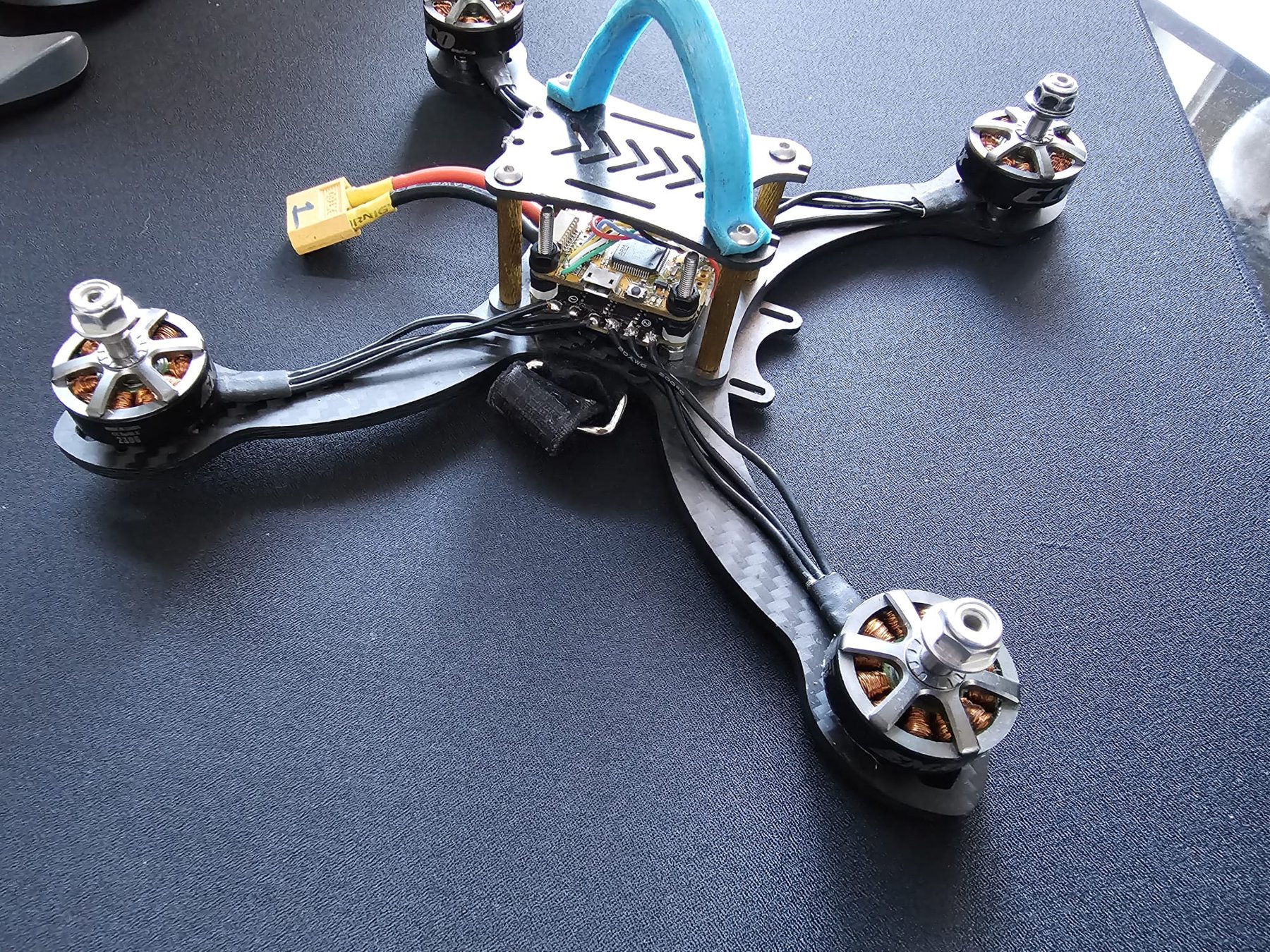
- AeroNU's FPV group races 5-inch quadcopters. Races are all sharp turns, so power-to-weight ratio decides how a quad flies.
- The team's older frame was bulky carbon fiber, heavier than it needed to be.
- Broken frames rarely end a race; propellers and cameras break first in a crash. That made weight a bigger priority than crash strength.
- My goal: a frame at least 30% lighter that still survives a full-throttle race launch.
What I did
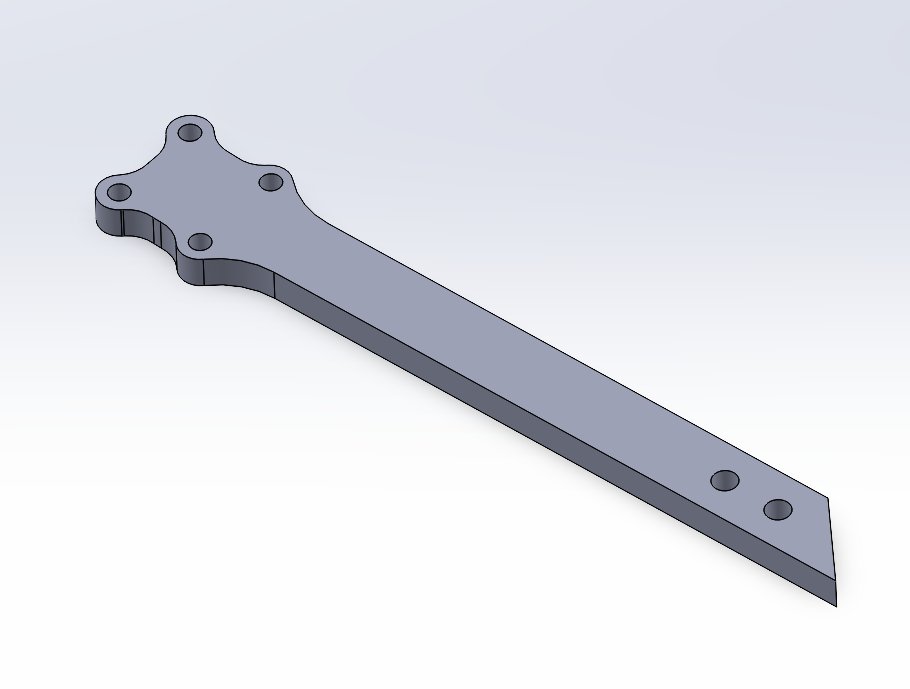
- Traced the original plates on paper, measured them with digital calipers, and rebuilt them in SolidWorks.
- Designed a new frame with straight arms that follow the carbon fiber's direction, based on current race frames.
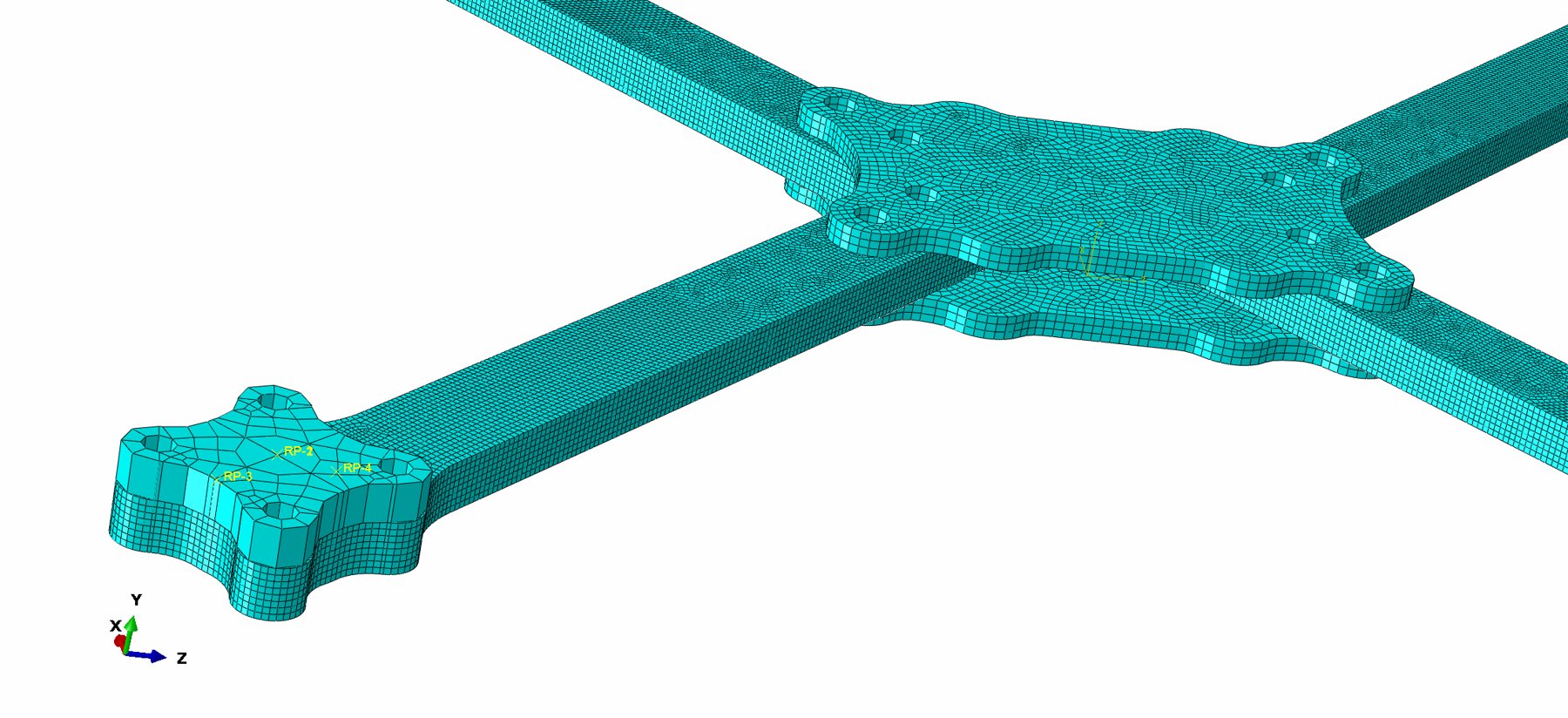
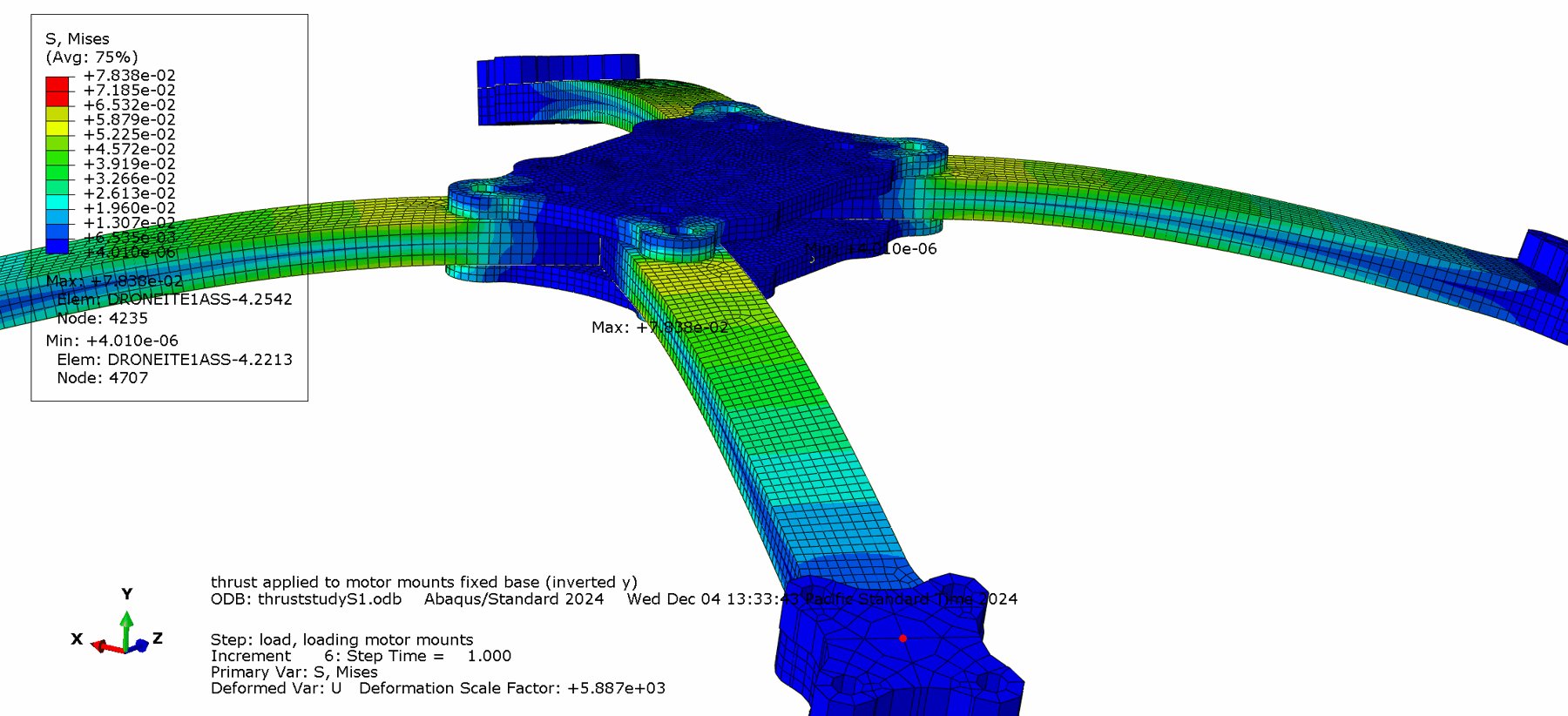
- Exported both frames to Abaqus with the body plate fixed and full motor thrust on each motor mount.
- Partitioned the arms for a cleaner mesh and refined it over four seed sizes until displacement converged.
Result
- Frame mass fell 47%, from 66 g to 35 g, beating my 30% goal. The whole quad is 5% lighter (615 g to 584 g).
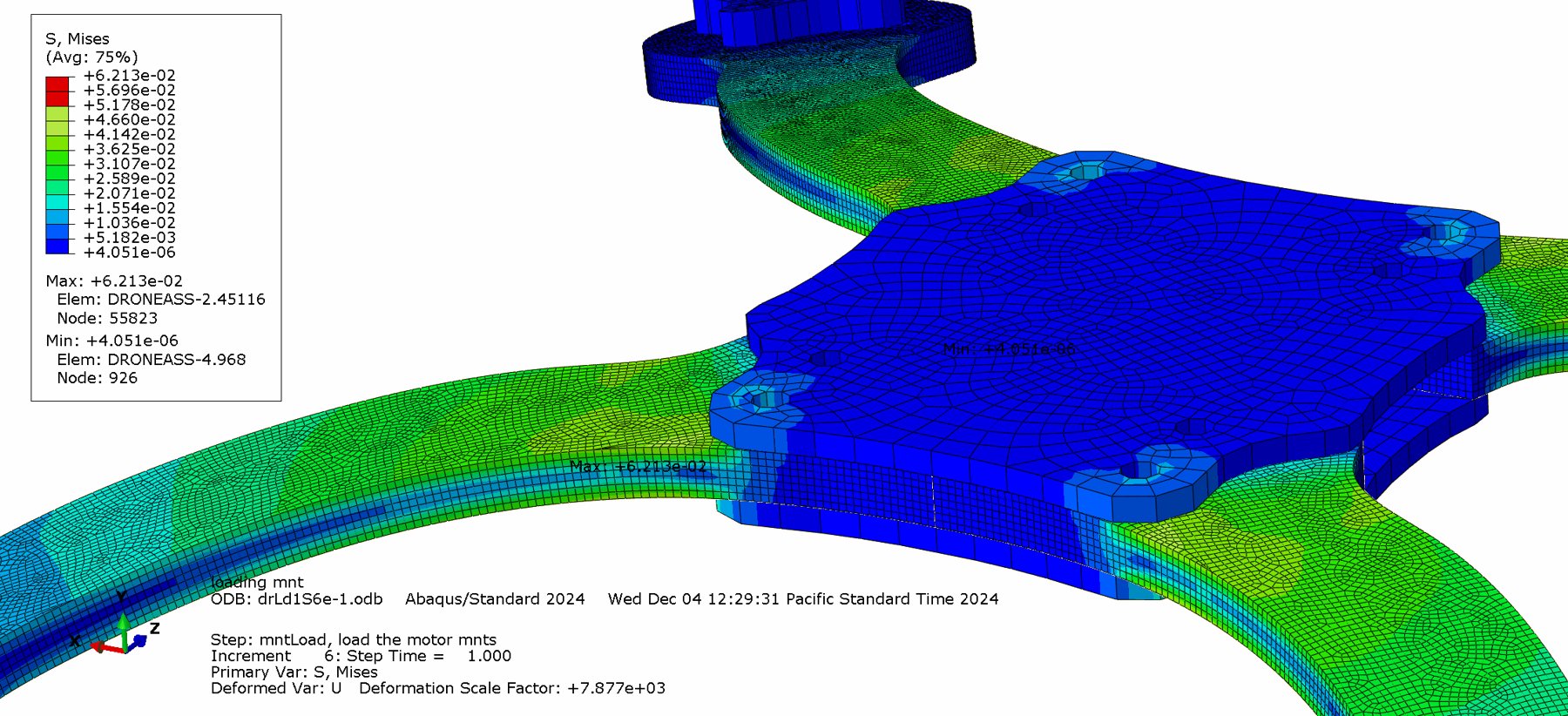
- A hand calculation puts peak bending stress at about 71 MPa at full thrust, roughly twice the original arm's. That leaves a factor of safety of about 4 against a conservative 300 MPa strength.
- The same check showed my FEA loads were about 1,000× too small, a units error. Haven't we all had a professor reiterate the importance of a quick hand calculation before pouring hours on a simulation?
- Next: modal analysis on the new frame, then cut a prototype and flight-test it with AeroNU.
Skills used
- Reverse-engineering a physical part into CAD, then setting up loads, boundary conditions, and mesh convergence in Abaqus.
Smart-home IR and Radio Bridge
The problem
- Air conditioners and lamps of mine only work with their own remotes, over infrared or 433 MHz radio. Nothing can automate them.
- Most commercial bridges depend on a vendor's cloud. I wanted everything to run locally on my own Home Assistant server, and I expected to build it for less than buying one.
- My goal: one small board per room that can learn and send both IR and 433 MHz commands.
What I did
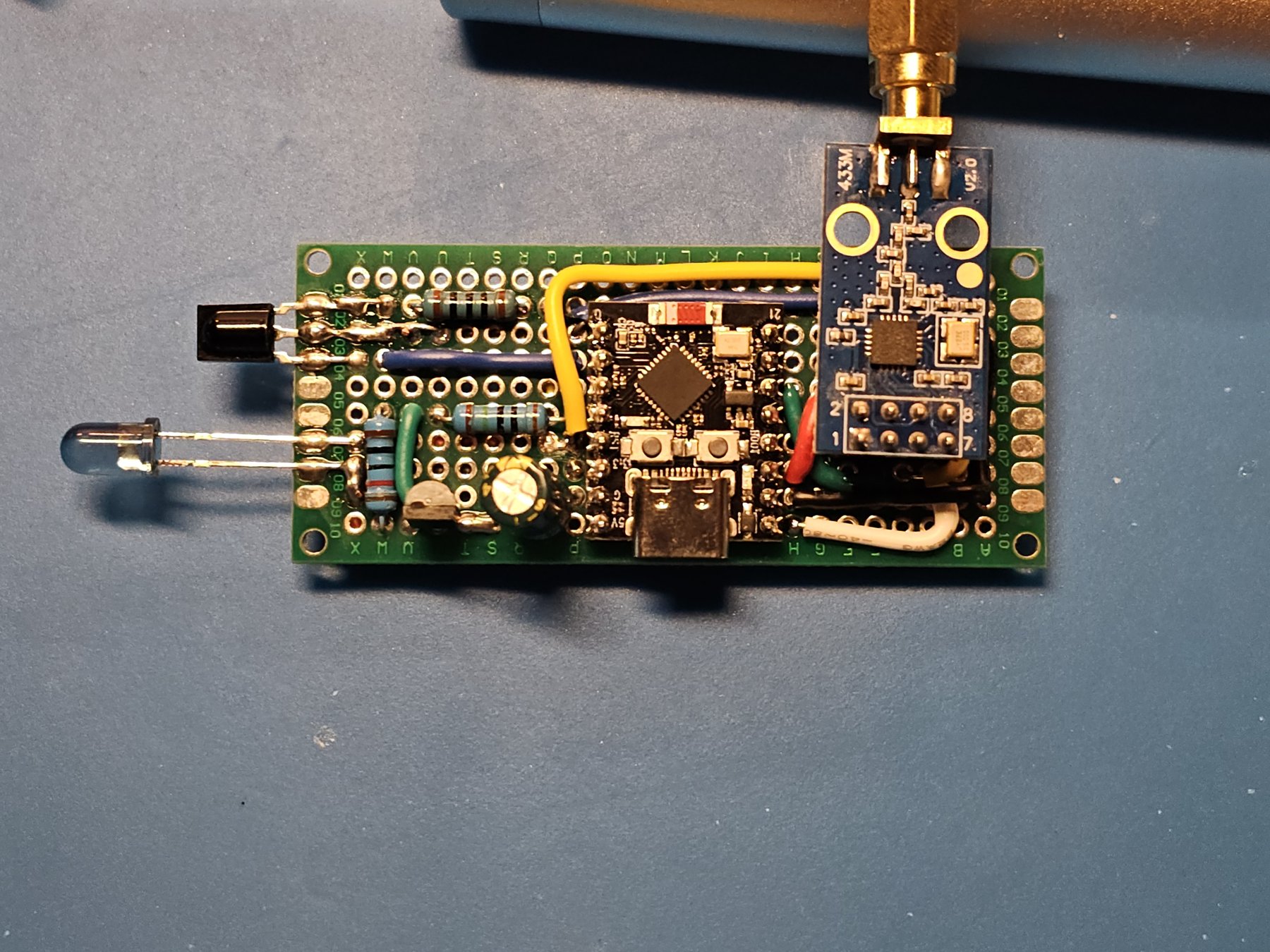
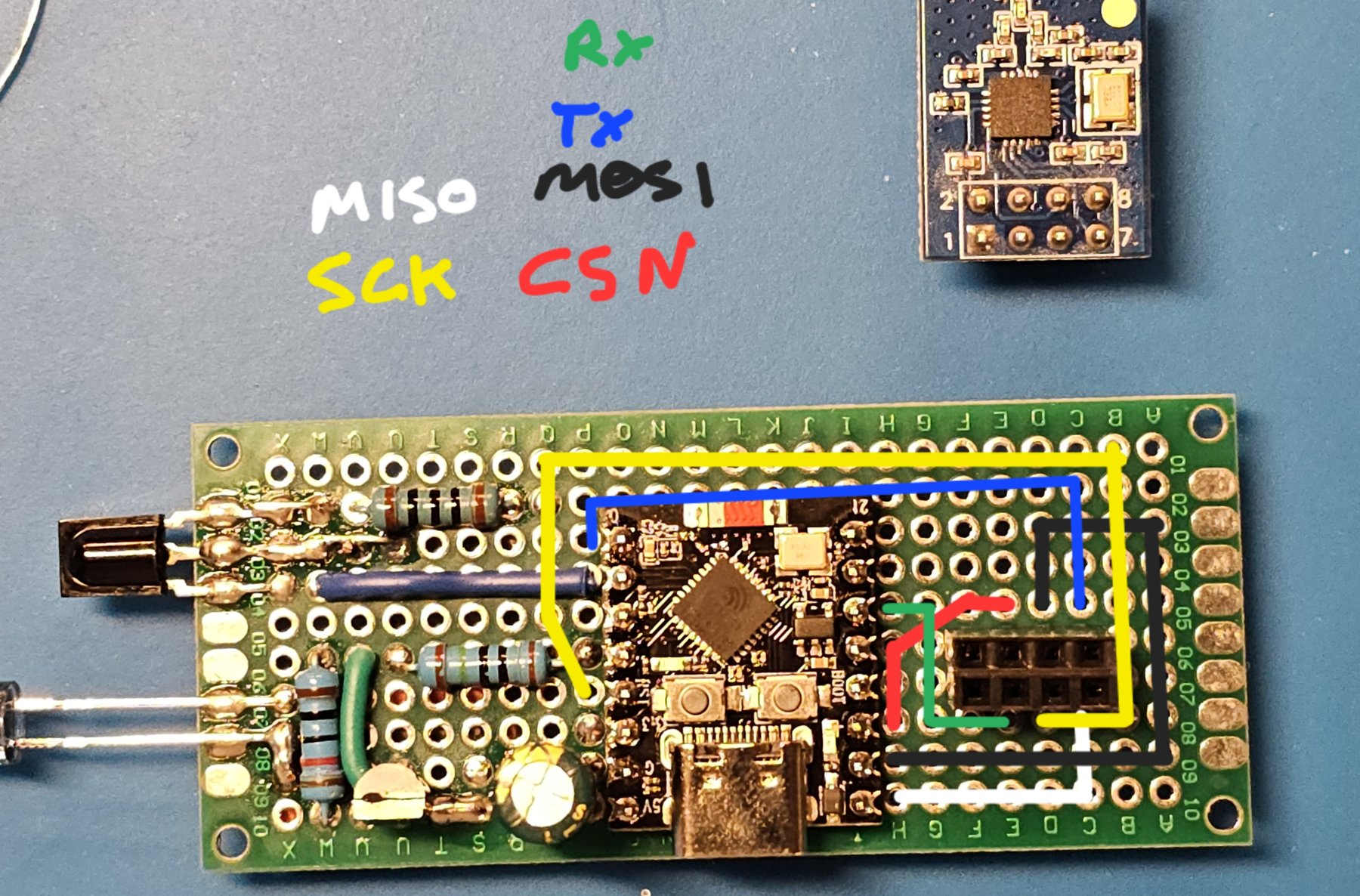
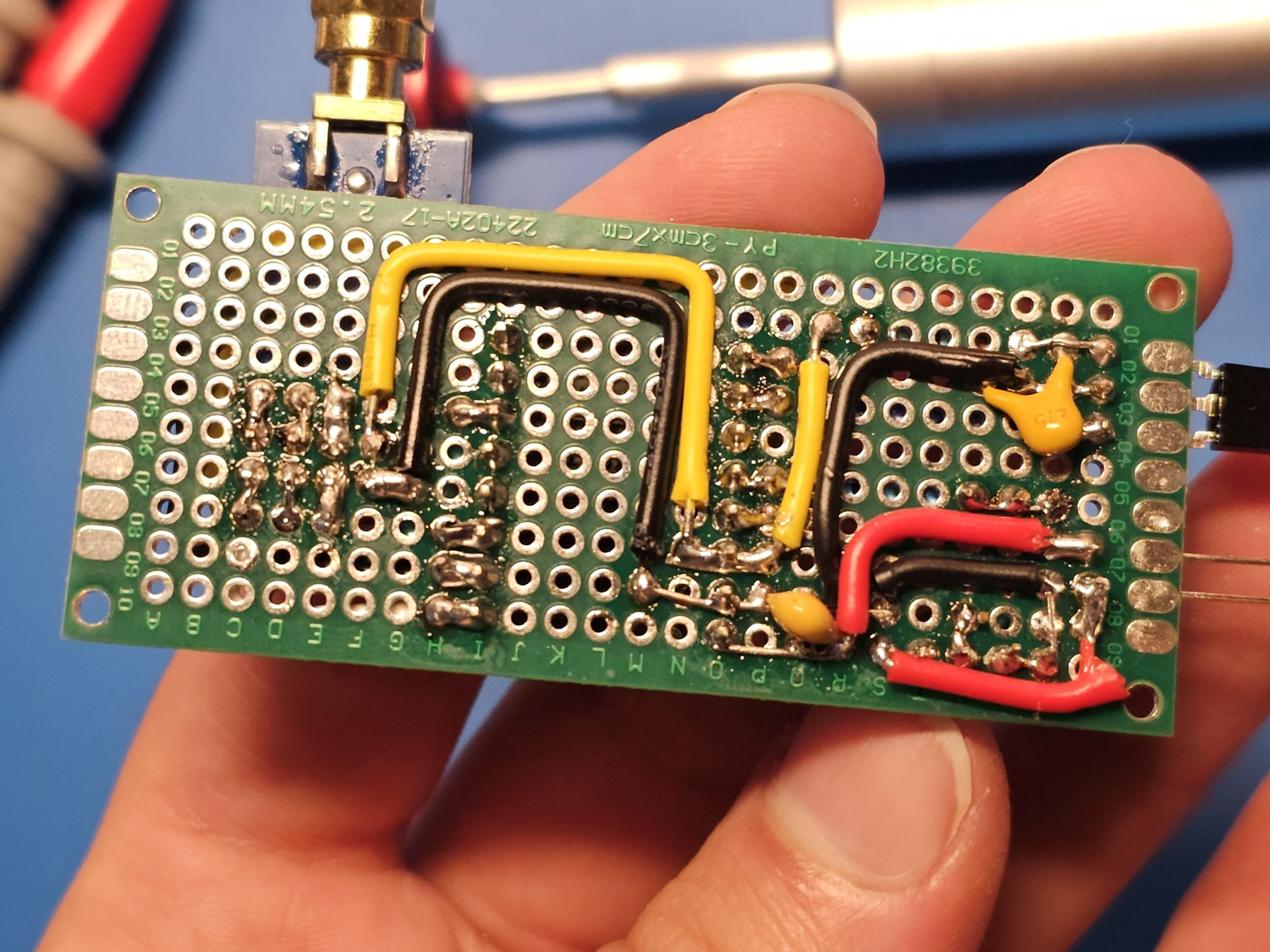
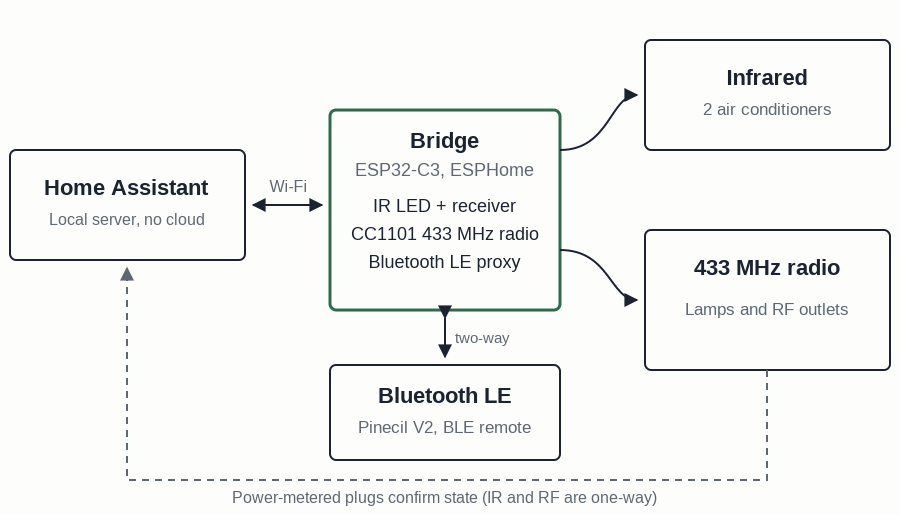
- Designed and hand-soldered the board: an ESP32-C3, a transistor-driven IR LED, an IR receiver, and a CC1101 radio on SPI.
- Captured each remote with a Flipper Zero and automated the decoding of the raw signals with LLM help.
- Captured the same lamp button twice and compared the signals. They matched, so the lamps use fixed codes, not rolling codes.
- Fixed three errors. IR receive failed until I traced it to a missing solder connection. A datasheet site listed the transistor as PNP; a diode test showed NPN. The Flipper read 434.075 MHz; the FCC filing says 433.92 MHz.
- Added a Bluetooth LE proxy to the same ESP32-C3 firmware in November. It still fits in 4 MB of flash with OTA updates.
- The Pinecil V2 soldering iron wouldn't show up through the proxy. Home Assistant overrode my active-scan setting and ran the proxy passive, and the iron's 128-bit service UUID sits in a scan response that passive scans never request. One pairing through a temporary USB BLE dongle on the Home Assistant host fixed it; the iron now reconnects over the proxy alone, even after a power cycle.
Result
- Home Assistant now controls two air conditioners over IR and three lights over 433 MHz, and reaches a Pinecil V2 and a BLE remote through the proxy, with no cloud involved.
- I mapped one AC's full command set and proved it complete by sweeping the neighboring codes with no response.
- Limits: IR and RF are one-way, so power-metered plugs confirm state where possible (ACs). The lamp has no direct brightness command, so scenes take 5 to 10 seconds.
- Next: dashboard controls, then one board per room.
Skills used
- Circuit design and soldering, IR and radio signal analysis, embedded firmware (ESPHome), and Bluetooth LE debugging.
Let's talk
I'm looking for a product design co-op. The quickest way to reach me is email.
- linkedin.com/in/gabriel-cauac
- Résumé
- Available on request